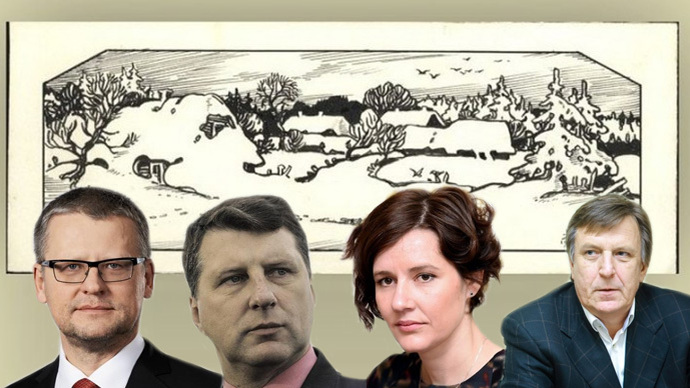
57 Days of the Kučinskis Government
Although at the time of writing the Kučinskis government had only been in office 57 days and it is still too early to evaluate the government's work, certain outlines of the ministers' activities are beginning to emerge, and it is unlikely that, as it approaches the 100-day mark, the government's profile will change substantially.
After a particularly aggressive campaign that began immediately after the 2014 Saeima elections, Vienotība with its representatives of the "little bear" and "grandma" variety was pushed aside, and - oh, what a surprise - on 11 February 2016, the court nurtured in Puze parish came to power: ZZS. The king of Puze himself again decided to remain on the sidelines. Instead, now the government has a full set - everything is green and agrarian, quite as in Soviet times. Both the President and the Prime Minister are cut from the same cloth.
Māris Kučinskis (ZZS)
Kučinskis (ZZS) was born in 1961 in Valmiera. In 1988 he graduated from the University of Latvia. From the scant information in public sources, one must conclude that he did not get swept up in "flower trading" in the nineties, and at the age of 33 became mayor of Valmiera. What he did before that and who his parents are/were is not known. What is known, however, is that along with the brilliant political career and the consolidation of his status in society, his existing wife apparently no longer fitted his new role, and a gaze was cast at a twenty-year-old public relations specialist named Laine, working right there in the city hall, who also became his second wife.
The government's head has not particularly distinguished himself so far, except for the fact that he does not speak or understand English - which would still be only half the trouble - but upon travelling to Brussels, realised that he has no "friends" there. Unlike the former President Bērziņš, who for the same reason characterised a planned trip to the World Economic Forum in Davos as a "leisure trip" and did not go, Kučinskis did travel to Brussels and did shake Schulz's hand.
Raimonds Vējonis (ZZS)
Vējonis (ZZS), who shortly after taking up the presidential post was afflicted by a nasty illness, came - immediately upon recovery - with a charming proposal: to make medical services more accessible... to the power elite (and those close to the power elite)! In principle, the idea was presumably to revive a pearl of Soviet times - the special ward at Linezers, where not only would the lumpenproletariat not get underfoot, but the best doctors would be gathered, who would accordingly also be paid better for their work. From the state budget, naturally.
Guntis Bēlēvičs (ZZS)
On the subject of medicine. Bēlēvičs (ZZS) took up the post of Health Minister on 5 November 2014. His first visible debut as minister - to ban in schools not only everything sweet or salty, but also bread rolls. Nutrition must be balanced. Full stop! The second matter - the hopeless "e-health" project. While L. Straujuma did nothing but "express outrage" everywhere and about everything, the Health Minister pointed to the similarity with skola.lv, where after long and careful service reviews and investigations, an exhaustive conclusion was reached - "the project has not succeeded." And that was that, because the responsible persons, apparently sensing the smell of smouldering, had shuffled off to other posts and very possibly continue to manage similar projects. But the minister is determined to resuscitate this Frankenstein.
It could not be said that Bēlēvičs came and messed everything up. It appears that healthcare has simply entered a state of zugzwang*.
* a term in chess denoting a situation in which any move further worsens the existing position.
Dana Reizniece-Ozola (ZZS)
Wikipedia states that Reizniece-Ozola is a chess player and politician. Also a mother of four children and Finance Minister, who in her time free from minding children "dashes off" to the ministry. Such too is the appearance of her performance in the political arena - somewhat childish and disjointed.
The minister is endowed with inexhaustible energy and bustle. Although her actual achievements are not much to speak of, she is present everywhere. For example, in April she planned to attend the World Bank and International Monetary Fund annual meeting, at which, as she herself notes, "it will be a new experience for me." It is possible that a political career propelled the minister to the glass summit too rapidly, because a ministry is not quite a students' project week, where it would be appropriate to delight in "what new thing I learned today". The people would rather see in ministers professionals who have not only a plan but also ideas on how to implement it.
One good thing the minister did do - she postponed the plan to liquidate micro-enterprises, over which ominous clouds had gathered during the previous minister's time. Although micro-enterprises are an absolute evil for the state economy (and freelancers should simply be hanged by the bell), the market situation in Latvia is what it is - buy low, sell high. Preferably cash in hand.
Rotation of State Revenue Service Staff
But the shadow economy turned out to be only the buds - the flowers are in the civil service and in particular the State Revenue Service (VID) bureaucracy, which compared to Estonia is twice as large, and moreover officials in some inexplicable manner manage to acquire notable assets and savings "in a sock". Until now, VID boss I. Pētersone had sunk so deeply into self-satisfaction that she managed to infect the supervising ministry with it too, which through various supplements and bonuses provided Pētersone with a remuneration equivalent to a second and perhaps even a third and fourth salary.
But journalists began to dig and unearthed the fact that several VID officials live beyond their means. Within a few days, a "blacklist" was placed on the desk of Minister Dana Reizniece-Ozola. Initially with 173 persons, then, apparently, Pētersone realised that if things were taken so "deep", there would be no senior staff left at VID at all, and this list was shortened to a dozen or so persons. But even with a dozen or so persons there is one problem - it turns out the Labour Law is written so "correctly" that a dishonest employee cannot simply be dismissed. Since Pētersone has no plan for how to "squeeze out" these employees, they will be "rotated", in the hope that they will work things out on their own.
State Enterprise Supervisory Boards
In the heat of the crisis, V. Dombrovskis (V) went ahead and liquidated the feeding troughs of political parties - the supervisory boards of state enterprises. Political opponents merely shrugged, since the opposition had nothing to gain from them anyway. The situation has changed. Transit from Russia has shrunk, but the parties need money. ZZS hastens to point out that, look, even the OECD - the club Latvia is determined to join - might start to be interested: how is it that state enterprises are without political oversight? Perhaps they wouldn't, but who cares - the boards must be restored!
Centre for Demographic Affairs
One of the National Alliance's ultimatums in forming the Kučinskis government was the demand to establish a Ministry of Demographic Affairs. It goes without saying that the National Alliance had "ideas" about who could be its minister - Imants Parādnieks. The ministry was not established, but with the Prime Minister's help a Centre for Demographic Affairs was created, in which alongside Parādnieks himself and "technical" staff, 9 additional persons will work - who are apparently so bored in their main jobs that for a certain remuneration during working hours they could "plug in" to demographic matters as well.
Against the global backdrop, where overpopulation reigns, one billion people suffer from hunger and 300 children die of starvation every hour, fussing over low birth rates looks like self-indulgence. English scientists discovered long ago that the higher the level of education, the lower the birth rate, and vice versa. English scientists have also discovered that people with lower levels of education more frequently consume white bread (and bread rolls). :)
So we live on in our "moss village", which puffed up with pride, in our unwavering life wisdom, we lovingly call Latvia.
comments