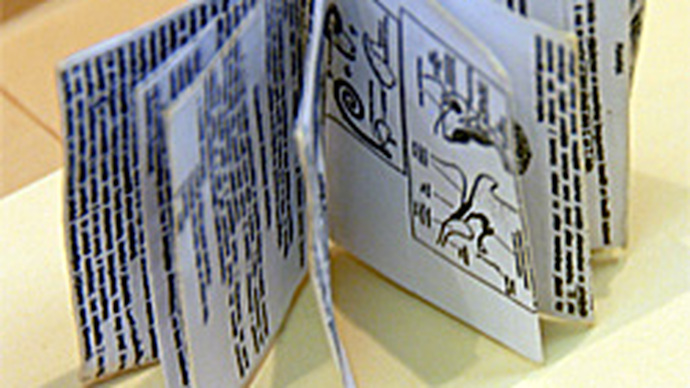
Types of Cheat Sheets, or a Brief Guide to Cheating
Whatever your memory capacity and however much time you invest in memorising "everything" in as short a time as possible, it is not within everyone's power. And this is where a word half-spoken in advance, a glance at a notebook, or better yet a sample with a similar task would come in very handy. Cheating is one form of laziness which, turn it as you will, is also a driver of progress.
 One of the essential components of the learning process is the selection and retention of information. Retention can be short-term, medium-term and long-term. Short-term, when it is necessary to read a certain amount of information and draw conclusions. Medium-term, when it is necessary to remember something for the next day's test or exam. Long-term - the ability to build in the brain a stable framework that allows one both to remember the fact of having remembered and the material itself. Incidentally, most people remember associatively rather than factually, which means it will be difficult to remember a physics formula without knowing anything about the process it describes.
Do not listen to the blathering of those educators who claim that nothing needs to be memorised and that what matters is knowing where to look things up. It is true that information has increased and become more varied, but that is precisely why there is a curriculum that determines what is worth memorising and what you can, so to speak, simply take note of.
Whatever your memory capacity and however much time you invest in memorising "everything" in as short a time as possible, it is not within everyone's power. And this is where a word half-spoken in advance, a glance at a notebook, or better yet a sample with a similar task would come in very handy.
The Cheat Sheet
Cheating, or copying, is one form of laziness which, turn it as you will, is also a driver of progress. How the word "špikot" arose in Latvian could not be found, so I will share my own subjective interpretation:
In German [1] - Spickzettel. Possibly derived from Spicke - to peek, and Zettel - slip, list. So: a peeping slip.
In Russian - Шпаргалка (in slang - шпора). The word's origin can be explained through school slang. In the plural, шпаргалы means unnecessary, old things. Similar-sounding words are found in Ukrainian "шпаргал" and Polish "szparga," which mean roughly the same thing - something old and unnecessary. Strangely, Google Translate renders "Шпаргалка" as "crib."
In English - cheat sheet. Cheat - to cheat, and sheet - a page. So, using a cheat sheet without the teacher's knowledge constitutes cheating.
In Latvian, one could connect it either to the German-sounding origin or to the word "spīkers" meaning a speaker or prompter. It is clear that in different cultures the word "cheat sheet" carries different meanings.
Ethical Considerations
I hope that for most readers the assertion that cheating is bad - is not news. Cheating, or falsifying one's actual knowledge at the moment of testing, is a reprehensible act and can end at best with a reprimand, at worst with the test being invalidated.
The Teacher's Response
The bad news is that a teacher notices in 99% of cases, if not the actual act of copying, then certainly something suspicious in your behaviour. You cannot even imagine how clearly visible a classroom is when standing in one corner of the room. If copying is conspicuous, the teacher's ultimate response is to expose the cheating and end your participation in the test. There is one and only one reason for this - not to set a precedent and not to allow the other participants in the test to question the objectivity of the work or act similarly.
Upon noticing a possible instance of copying, a teacher may act as follows:
- The teacher reprimands you. This is a sad signal, as most likely one more reprimand will lead to a final decision.
- The teacher comes over and stands nearby for a while. In 99% of cases this is not a coincidence and serves as a signal that your copying has become too conspicuous.
- The teacher watches for a while. A 50/50 situation. Either they are not certain you are actually doing something forbidden, or action will follow very soon - i.e., they will come over and tell you that your test is over.
- The teacher comes over and reads your work. If you really have been copying - this is a hint with a blunt stick that you should not do it so conspicuously.
- The teacher changes their observation spot. Bad for your copying strategy, but no real cause for alarm.
- The teacher starts doing something else. Two possibilities - a generous gesture meaning that within the bounds of reason and inconspicuously you may copy, or a provocation, as sooner or later the copier will let their guard down and fall into the trap.
If the Cheat Sheet Falls.
There is cause for concern, depending on the type of cheat sheet. If it is a permitted study aid - a book, ruler, pen or an identically sized sheet - there is less cause for alarm. If it is a prohibited item - a book or notebook, a cheat sheet slip - then the options are as follows:
- A classmate will give you away by drawing attention to it - by looking or laughing. That's it! Game over! Unless something less damaging happened simultaneously, for example a pen fell along with the cheat sheet.
- The cheat sheet fell directly between the rows. If the teacher has not noticed and is in a position where they cannot notice (or can pretend not to), it must be retrieved as quickly as possible. In the worst case, by destroying it - sliding it somewhere out of sight. Standard procedure: hand the person next to you a pencil or eraser (even if it is not needed) and collect the piece of evidence.
- If the cheat sheet fell under the desk. Place a foot, bag or whatever is permitted on top of it. Wait for a convenient moment to pick it up. Dropping a pen and bending down after it is a poor scenario, but can work.
Types of Cheat Sheets
|
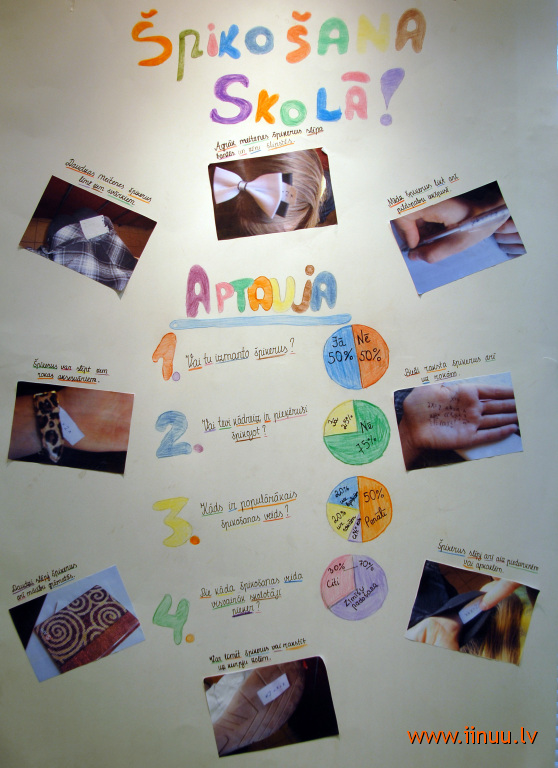
The Lazy Cheat Sheet Copying takes place from a notebook or book. Copying is complicated, but no cheat sheet preparation is required. For convenience, you can fold back the corner of the page. |
 |
|
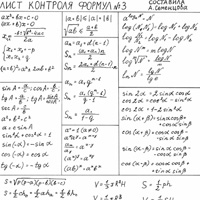
The Book Page Cheat Sheet Slightly more refined than the lazy cheat sheet, but not by much. The cheat sheet is a page torn out of a book. |
 |
|
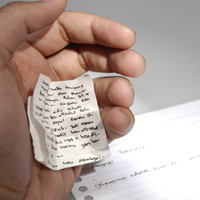
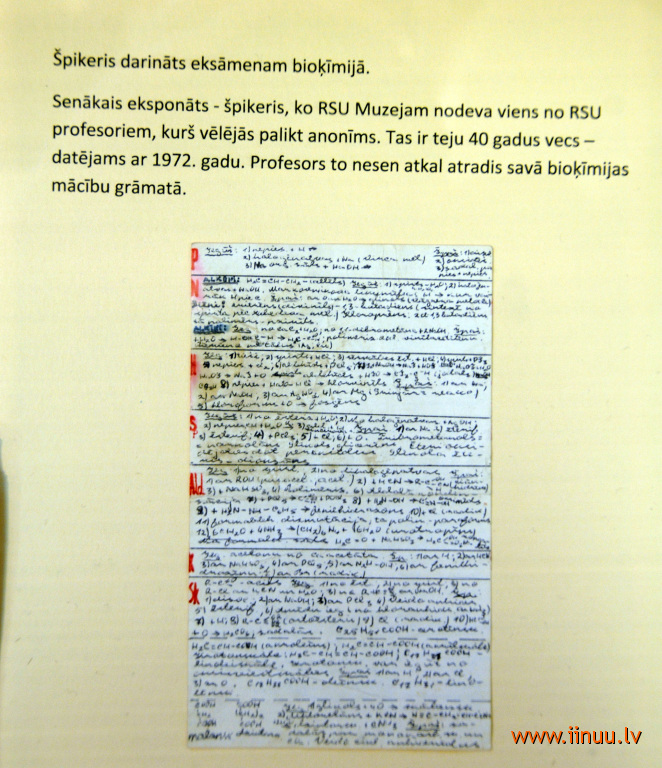
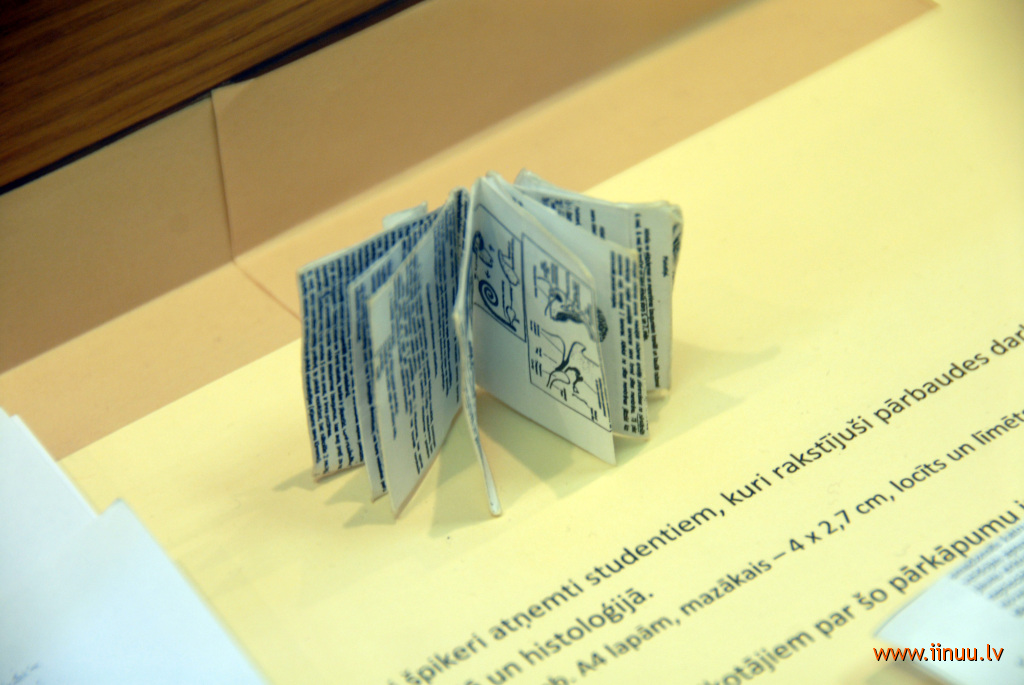
The Standard Cheat Sheet A small-sized slip of paper on which answers or formulas are written in tiny letters. The most advantageous position in the classroom is in the middle, so you can hide behind the back or arm of the person sitting in front, or behind some other object. Effectiveness - 25–50%. |
 |
|
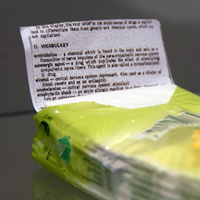
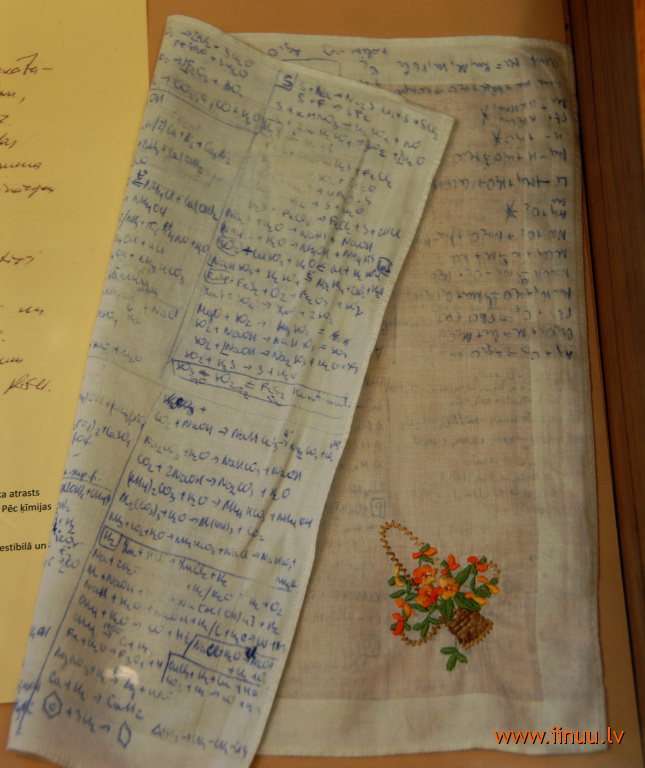
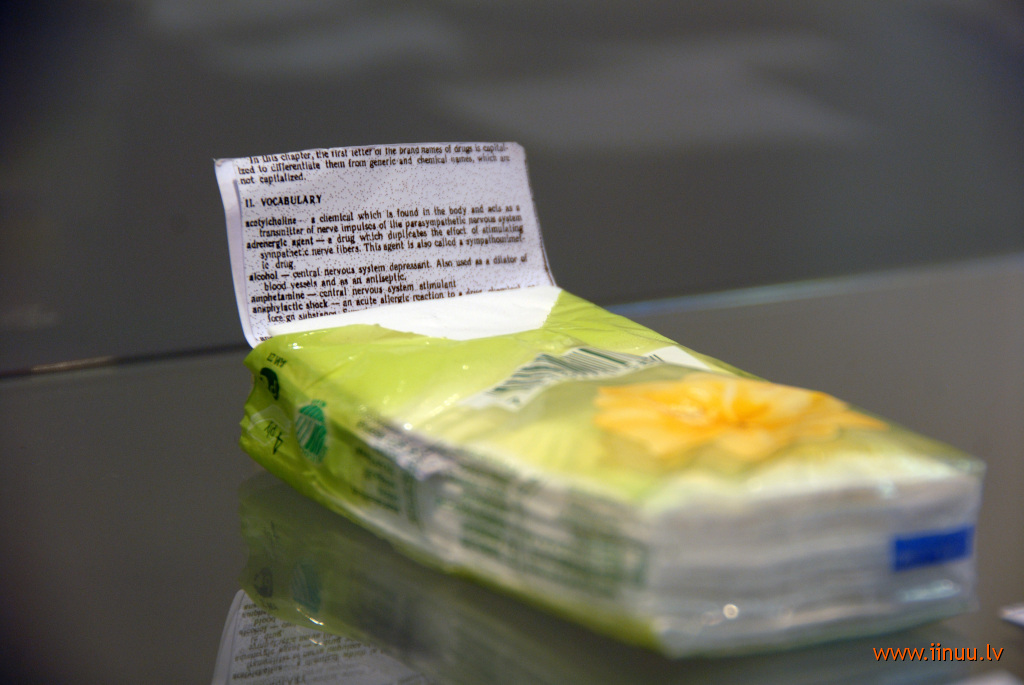
The Handkerchief The cheat sheet is written on a paper (or fabric) handkerchief. A softly sharpened pencil writes best on it. |
 |
|
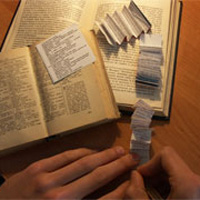
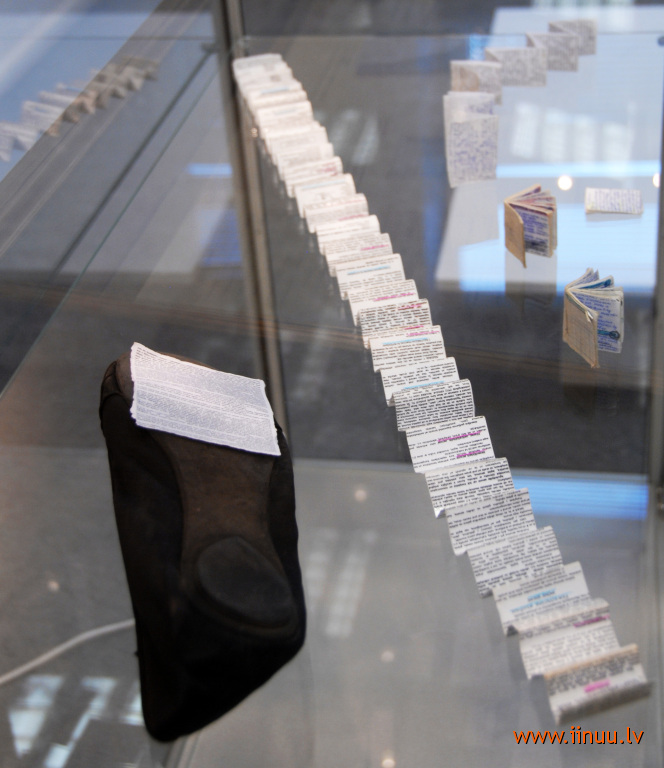
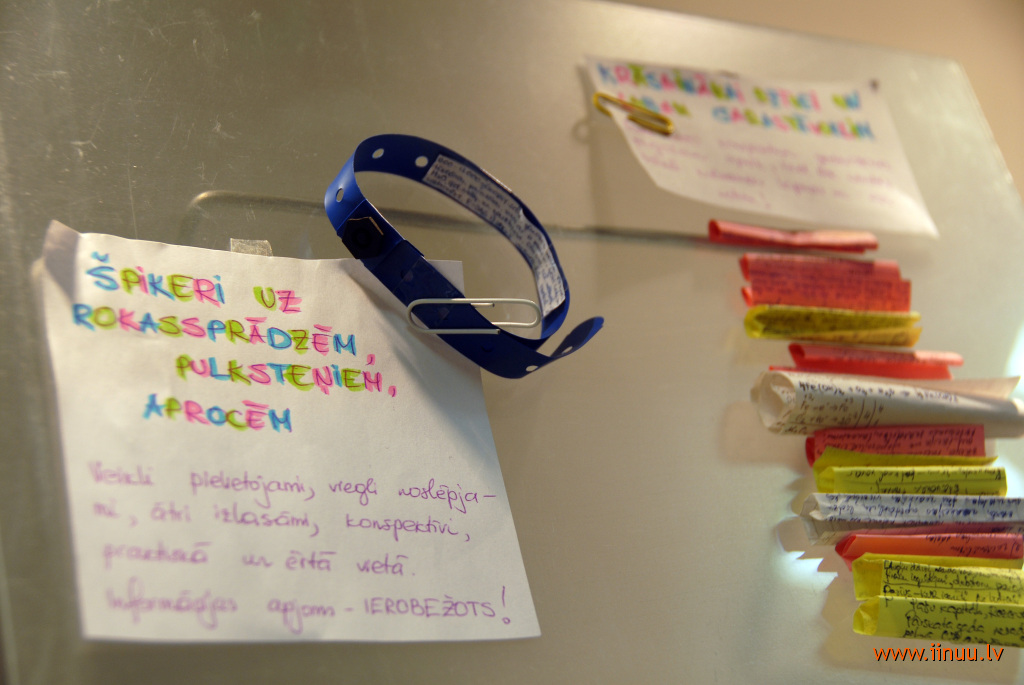
The Accordion Text is written in tiny letters on a long paper strip, which is folded at regular intervals (~4–10 cm), alternating direction. To avoid mixing up the answer variants you can fold it in advance. When in use, it is leafed through with the thumb. Can be written on both sides. Effectiveness similar to the standard cheat sheet. |
 |
|
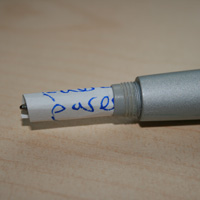
The Roll (or Papirosa) Similar to the accordion, written on a long strip of thin paper. It is rolled up and placed either in order in a close-fitting pocket or inside a pen. Incidentally, mothers and grandmothers even sewed special belts with little pockets for rolls of this type, fastening them at the waist or on the leg under a skirt. |
 |
|
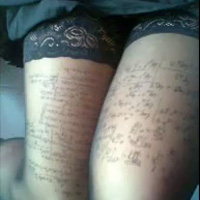
On the Palm (Hand, Leg) Cheat sheets can also be written on the hand (usually the inner side), palm or leg. The latter is more suitable for girls, as it can easily be hidden under a skirt. |
 |
|
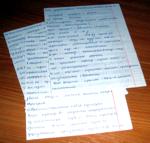
The Bomb On an identically formatted sheet (which must be established in advance) the correct answers are written out. At the start of the exam, the right slip must be found quickly and submitted at the end. To avoid looking suspicious, something can be written on the issued sheet as well. Two risks. First - the test may have several questions. In this case, there is no choice but to write out only one - usually the first, as that is most often the theoretical one. Second - you may not match the paper size, and the paper texture may differ. |
 |
|
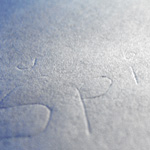
The Invisible Bomb Prepare your answer by writing on two sheets. When writing with a ballpoint pen, press harder so that an impression is left on the second sheet. Take the second sheet (the one with the impression) to the exam, find the angle from which the impression is most visible, and write over it. Similarly, this can be done by writing the answers in pencil. During the exam, copy them over in pen and erase what was written in pencil. |
 |
|
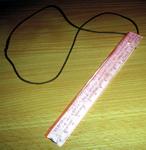
Ruler or Calculator If a calculator is permitted in the exam, the required information can be scratched or written in pencil or pen on the back of the ruler or calculator. If the eraser is large enough, on the back of that as well. The same can be done with a chocolate bar. |
 |
|
MP3 Player Record each answer as a separate track. At the start of the exam, find the relevant track, listen and write. Problem: if players are prohibited, or the room is very quiet, even the slightest sound will be heard and draw unwanted attention from both the teacher and classmates. |
 |
In Closing
I have already said that copying is bad. In the event that you were caught anyway, the best option is to study everything and next time, coming to the test, sit in the front row directly opposite the teacher. Even if this is a bluff on your part, there is a chance the teacher will be surprised and believe that this time you have genuinely studied, and will not pay such close attention.
From personal experience I have observed that the most versatile are accordion-type cheat sheets and a jumper (so you can slide them into the sleeve). My favourite spot is the middle-right, because then the left hand serves as a cover regardless of whether the teacher is at the front or back of the room. If possible, type your cheat sheets on a computer, then reduce the font size and print on thin paper.
Bear in mind that it is better to defer an exam due to not knowing the material than because you were caught cheating!
Various types of cheat sheets and their use. Video in Russian from the TV programme Galileo.
[1] http://de.wikipedia.org/wiki/Spickzettel
[2] http://ru.wikipedia.org/wiki/%D0%A8%D0%BF%D0%B0%D1%80%D0%B3%D0%B0%D0%BB%D0%BA%D0%B0
[3] http://en.wikipedia.org/wiki/Cheat_sheet
[4] http://www.sgu.ru/massmedia/studgorod/44524

comments