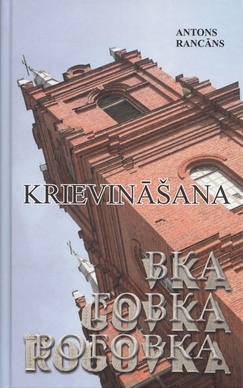
A. Rancāns "Russification". Quotes.
They had neither a home nor possessions, and all their wealth was what they could put on their backs: one quilted jacket, one pair of trousers, one pair of imitation leather boots. Sometimes various shiny aluminium rattles were pinned to the dirty quilted jacket to command respect - they called them orders or medals.
The juiciest phrases:
A name implemented by Slavophiles.
The voluntary efforts of officials.
The dictatorship of power-hungry paupers.
Philosophises about where the earth goes when you drive in a stake.
Quotes:
Under Russian law, nobles sentenced their serfs without any investigation or trial, and for the killing of a peasant, when proven, the fine did not exceed 30 roubles. (p. 16)
(After Latgale's incorporation into the Soviet Union) The take-home (teacher's) salary was therefore only 579.02 roubles, for which at that time one could buy approximately 24 pens or 10–15 bottles of vodka, depending on the quality of the drink. (p. 29)
Despite oppression and persecution, the Poles preserved their language and Catholicism. (p. 31)
The typical Russian obscenities also rolled just as naturally off their (the German nobles') lips, for they could not swear in Latvian, and swearing in German was pointless - the peasants would not understand anyway, or might even imagine that the master was praising them. (p. 32)
Orthodox churches were built at state expense even in places where Russians were a rarity. The primary aim was to create a centre around which the Orthodox settlers who had moved in could gather. (p. 35)
Therefore the abolition of serfdom brought the peasants no relief, for among several thousand serfs of a particular estate there was not a single one who could read and explain to others the substance of the emancipation manifesto. (p. 39)
[..] and Latgalian girls not infrequently preferred Russian lads, as they were both louder and more insistent than their own, which increasingly appealed to the yearning Latgalian girls. (p. 39)
In place of his (Pīters Miglinīks') songs, alcoholics, in order to please the colonisers, wailed "Volga, Volga, mat' rodnaya...", even though they lived on the banks of the Ičas river. (p. 41)
Over several generations the peasants had been violently forced to speak Russian; their national consciousness had been destroyed, and the desire to submit had become a habit - and so they did not understand the efforts of their defender (Pīters Miglinīks). (p. 57)
In truth he (Pīters Miglinīks) was the first nationalist - far more serious and selfless than today's nationalists. Who today would willingly renounce material benefits in the name of the national idea? (p. 58)
While sympathising with those who suffered in the punitive expedition, one cannot fail to notice that the barley the peasants had taken from the estate storehouse was used not to make porridge or at least animal feed to provide more meat for the family's nourishment - but that they decided to brew ale so as to get properly drunk. (p. 60)
[..] Klementijs (the brother of Jānis Jurkāns, elder of Nautrēni parish) was successfully engaged in commerce. Reviews of him can even be found in the newspaper "Jaunas zinias" of the time. In the 51st issue of this newspaper, a resident of Nautrēni wrote that K. Jurkāns invited all churchgoers to his tavern for a drink before (!) the service. (p. 62)
If approximately 2,000 souls lived on the estate's territory and were served by 9 taverns supplied without restriction from the nobleman's distillery, one can say with reasonable confidence that our ancestors did not live sober [..] (p. 64)
When the children conceived in intoxication grew up, the cycle could repeat itself. With each new round the number of mentally impaired grew larger and larger, for their feeble-mindedness diminished sexuality not at all but rather increased it, and with it the number of children born mentally feeble. (p. 72)
In Latgale, taverns were usually managed by Jews, and it had been proven that they were more dexterous than others at selling drink, extracting the last kopek from the peasants. (p. 72)
Those conceived in intoxication we have begun to call indigo children, thereby in effect allowing that they are incapable of becoming adults and fitting into society. (p. 76)
To justify their addiction and their descent into poverty, drunkards have developed their own philosophy and maintain that poverty is no vice. (p. 79)
Lenin is said to have openly urged his associates to hang, shoot or secretly drown - only to sow terror and fear. This was done without restraint, as the killers were each time rewarded with 100,000 roubles. The Doctor of Legal Sciences Arkady Vaksberg, who has made a special study of Bolshevik terror, regards these killer fees as the forerunner of the Lenin Prize. (p. 100)
On the last day of the month, the social democrat deputy Opincāns arrived in Rugāji parish. While visiting a teacher's apartment, he broke a chair to demonstrate his power. Opincāns then climbed onto the table and began spitting. [..] (p. 114)
In this situation it surprised no one any longer that Jānis was called Ivan, Bārtuls Boris and Tenis Denis. (p. 129)
Since Lenin's time, nothing has changed in substance. Those who have come to power wish to remain there forever, and so professional liars are bought - called in the foreign word "image-makers" or "PR specialists" - and the people are deceived. (p. 135)
They had neither a home nor possessions, and all their wealth was what they could put on their backs: one quilted jacket, one pair of trousers, one pair of imitation leather boots, and as an indispensable component - a military-type bag slung over the shoulder, dangling on the right-hand side of the back. Yes, and also a cap with a shiny peak and a red star above it. Sometimes various shiny aluminium rattles were pinned to the dirty quilted jacket to command respect - they called them orders or medals. (p. 154)
"I'll send you along with your whole Lenin to the polar bears!" Thus spoke two Latgalians - an art historian and a Chekist. (p. 166)
The same happened in the education sector. In Riga, all mixed-nationality schools with Latvian as the language of instruction were closed and converted into Russian schools. Local Russians, following the example of the occupiers, began to call Latvians fascists. (p. 180)
"I will make every effort to justify the trust of the voters and to become the kind of deputy that Comrade Stalin wishes to see." (p. 180, ref: Padomju Latvija No. 109)
If someone owned their own house, their own shop, their own business, had silver tableware, fine furniture or a piano, they were automatically entered on the lists of enemies of the state and the people and labelled a plutocrat or parasite. This was followed by arrest, torture in the Cheka's chambers, and death. No person - no problem, as Iosif Vissarionovich put it. (p. 187)
Historian Ojārs Niedre: "To describe the mutual relations of LCP members as comradely and friendly [..] is entirely incorrect. These relations were characterised by marked mutual suspicion, a striving to advance, and a thirst for personal gain." (p. 193)
Already in his time Lenin revealed the truth that the state is an apparatus serving one class in order to suppress others. Laws are developed to implement this procedure. (p. 228)
The book can be purchased at the "Valters un Rapa" bookshop -
https://www.valtersunrapa.lv/book/lv.krievinasana.26476.html
comments